
How to Create EA Form for Employees (2026)
Every year, employers in Malaysia are required to prepare the EA Form for their employees. This form is essential for employees to file their personal income tax (e-Filing)…

As Malaysia moves further into digital tax compliance, understanding PCB (Potongan Cukai Bulanan) and preparing for accounting e-invoicing has become essential for all businesses. PCB ensures employees pay their taxes gradually throughout the year, avoiding a huge lump sum at the end, while e-invoicing connects your accounting system directly with LHDN reporting requirements.
Preparing early not only saves time and reduces errors but also helps your business stay fully compliant and efficient. This guide explains everything employers need to know about PCB, including calculation methods, factors that affect deductions, and how payroll software like Million Payroll can simplify the process.
PCB, or Monthly Tax Deduction, is a system where employers deduct income tax from employees’ salaries each month and remit it to LHDN (Inland Revenue Board of Malaysia).
Instead of paying a large amount during annual tax filing, employees pay a manageable monthly amount. PCB is mandatory for most employees and ensures that both the government and the employee stay on track with income tax obligations.
Without PCB, employees may struggle to pay taxes at year-end, especially if their income varies month to month. PCB helps smooth out the tax burden, providing predictability for both employees and employers.
PCB is not a fixed number. Several factors influence how much is deducted each month, and these must be taken into account to calculate it accurately.
Your employees’ basic salary, allowances, incentives, and bonuses all form part of taxable income. Any increase in income will naturally lead to a higher PCB deduction.
EPF contributions reduce taxable income, lowering PCB. For example, if an employee contributes 11% of their salary to EPF, their taxable income for PCB calculation is adjusted accordingly.
LHDN allows certain tax reliefs for dependents. Employees with a spouse, children, or other eligible dependents may see lower PCB deductions than single employees with the same salary.
Any additional payments beyond base salary, such as performance bonuses, commission payments, or special allowances, are considered in PCB calculations. Sudden bonuses can increase the PCB for that month.
Employees who submit a TP1 declaration can claim eligible tax reliefs, which reduce their PCB. This includes education relief, medical expenses, lifestyle relief, and more.
Because these factors can change throughout the year, PCB may fluctuate even if the employee’s base salary remains the same. Accurate calculation is therefore critical.
Calculating PCB manually can be tricky, but the process can be broken down into simple steps:
1. Total up monthly taxable income
Add salary, allowances, incentives, and any bonuses.
2. Deduct EPF contributions
Employee contributions to EPF reduce the taxable income used for PCB calculation.
3. Estimate annual income
Multiply the monthly taxable income by 12 to project annual earnings.
4. Apply LHDN progressive tax rates
Use the official tax tables to estimate the total annual tax liability.
5. Spread the tax across remaining months
Divide the total annual tax by the number of months left in the year to determine the monthly PCB deduction.
Salary adjustments, bonuses, or changes in employee status can all affect PCB. Manual calculation can easily lead to errors, which is why many employers now rely on payroll software like Million Payroll.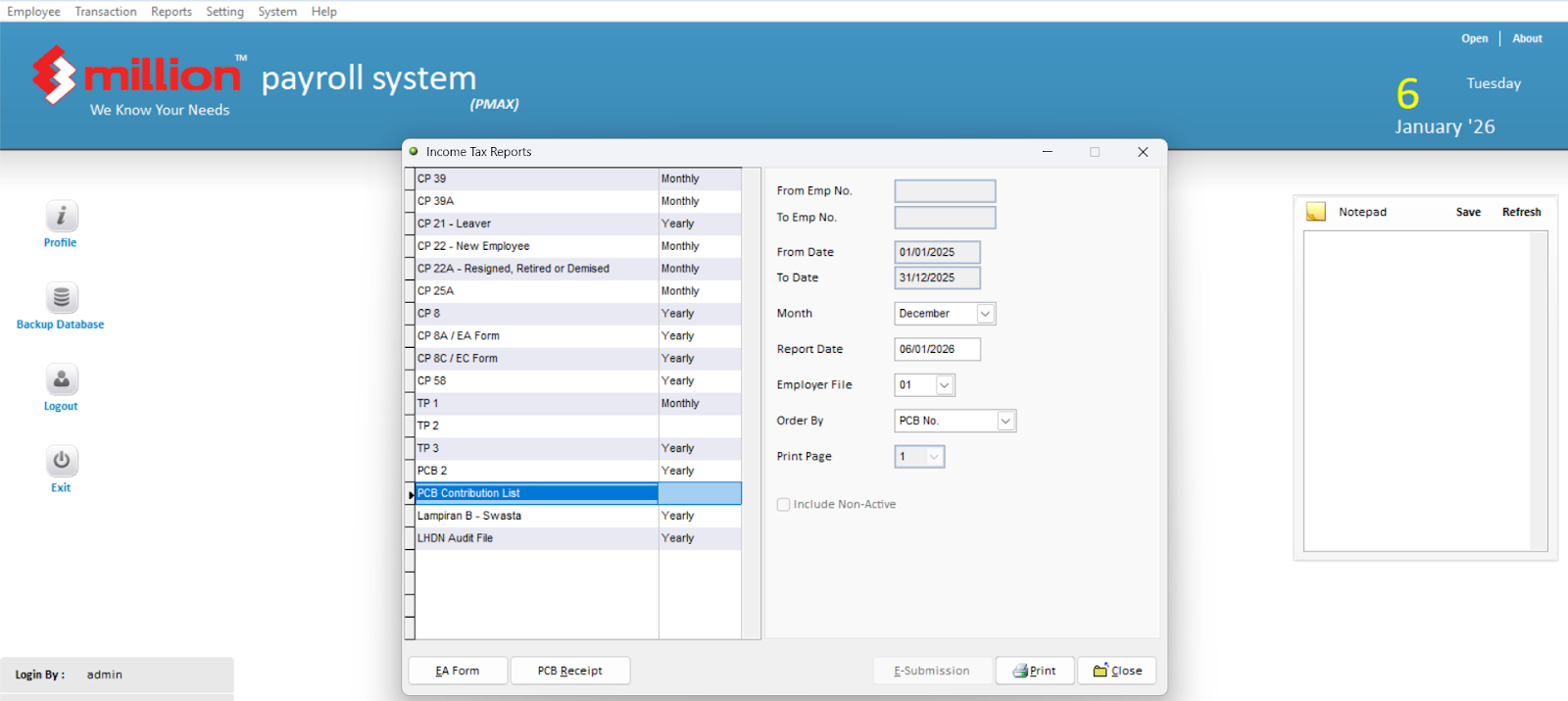
With Million Payroll, PCB calculation is fully automated and built directly into your monthly payroll process. This means less manual work, fewer errors, and consistent compliance with LHDN rules.
Here’s what Million Payroll does for you:
Beyond PCB, Million Payroll can also manage:
All processes are integrated in a single system, giving you full control and visibility.
PCB doesn’t just affect employees — it impacts business cash flow too. Employers must ensure enough funds are available each month to remit deductions to LHDN.
Yes. Any changes in salary, bonuses, or EPF contributions can affect PCB. For example, if an employee receives a performance bonus or salary increment, the PCB deduction will automatically increase in the following month to reflect the higher taxable income. Conversely, if an employee’s salary decreases or they take unpaid leave, PCB may be reduced. Automated payroll systems handle these adjustments seamlessly, eliminating manual recalculations.
Overpaid PCB is typically refundable during annual tax filing. Employees can claim the excess amount when submitting their tax returns. However, frequent overpayments can be avoided by using accurate, up-to-date payroll data and automated PCB calculation. Ensuring correct EPF contributions and declared reliefs are captured will also minimize overpayment scenarios.
Bonuses are considered part of an employee’s taxable income and are included in PCB calculations. This means a sudden bonus may increase the PCB deduction for that month. Modern payroll systems, such as Million Payroll, automatically factor in bonuses without requiring manual adjustments, ensuring compliance and preventing errors.
Most employees earning a salary in Malaysia are subject to PCB. However, certain categories are exempt, such as:
Employers should always check the latest LHDN guidelines to determine eligibility.
EPF contributions directly reduce an employee’s taxable income. The higher the contribution, the lower the taxable income, and consequently, the PCB deduction. Employees may also adjust voluntary contributions to reduce taxable income further, which will reflect in lower PCB. Payroll systems calculate this automatically.
Changes in marital status (e.g., marriage, divorce) or dependents can affect PCB deductions. LHDN allows certain reliefs for spouses and children, so payroll adjustments must be made to reflect these changes. Systems like Million Payroll automatically update PCB based on employee declarations, ensuring correct deductions without manual intervention.
Yes, taxable allowances, including housing, transport, or meal allowances, are included in PCB calculations unless they are explicitly tax-exempt. Proper classification of allowances in the payroll system ensures accurate PCB deductions and prevents discrepancies.
Yes, PCB applies to part-time or contract employees if their income exceeds the LHDN threshold. Payroll systems can calculate PCB proportionally based on their monthly income, including allowances and EPF contributions where applicable.
Overtime is considered taxable income and is included in PCB calculations. Payroll systems automatically account for overtime hours, calculate the corresponding pay, and adjust PCB for the month accordingly.
While PCB focuses on employee tax compliance, businesses also need to prepare for accounting e-invoicing, which is being phased in by LHDN starting in 2026. E-invoicing is more than a digital replacement for paper invoices—it fundamentally changes how invoices are generated, transmitted, stored, and reported. Proper preparation ensures compliance while improving overall business efficiency.
E-invoicing allows invoices to be:
Unlike traditional PDF or printed invoices, e-invoices contain structured data rather than just an image of a document. This allows for automatic verification of invoice amounts, tax codes, and customer details, reducing errors and streamlining reporting.
The e-invoicing rollout affects a wide range of businesses, especially those with annual turnover between RM1 million and RM5 million, including:
Even businesses that have previously relied on manual invoices or PDF systems must upgrade their accounting software to meet the structured data requirements of e-invoicing.
Preparing for e-invoicing early offers several advantages:
1. Accurate Reporting
Since e-invoices are generated directly from your accounting system and submitted to LHDN, the data reported is consistent with your internal records. This eliminates mismatches between invoices, sales records, and tax filings, reducing the risk of penalties and audit issues.
2. Faster and Easier Audits
With all invoices stored digitally in a structured format, businesses can respond to audit requests much faster. Instead of manually retrieving physical invoices or searching through unorganized PDF files, accountants can access detailed records instantly, saving time and reducing stress.
3. Better Financial Visibility
E-invoicing provides real-time insight into your business’s revenue, accounts receivable, and outstanding invoices. This allows managers to make informed decisions, identify late payments, and forecast cash flow more accurately.
4. Operational Efficiency
Automating invoice generation and submission reduces repetitive manual tasks for finance teams. Employees no longer need to manually enter invoice data, check for errors, or reconcile reports, freeing up time for higher-value activities such as financial analysis or strategic planning.
One of the most effective ways to prepare for e-invoicing is to integrate payroll and accounting systems. When payroll software (handling PCB and other employee deductions) is connected with accounting software for invoicing:
For example, a consulting firm using integrated payroll and accounting systems can automatically factor in employee bonuses, bill clients accurately, and report to LHDN without manual intervention. This reduces human error and ensures full compliance.
PCB calculation may seem complicated, but with the right systems, it becomes a straightforward, automated process. Understanding what affects PCB, preparing for changes, and using software like Million Payroll can save time, reduce errors, and ensure full compliance with LHDN rules.
When paired with e-invoicing-ready accounting software, businesses can streamline their financial processes, improve cash flow management, and maintain accurate records throughout the year. For employers, embracing automation in payroll and accounting isn’t just a compliance measure — it’s a step toward smarter, more efficient business management.
Book a free demo with our local team. We'll call you back within the same working day.
Request Free DemoEvery year, employers in Malaysia are required to prepare the EA Form for their employees. This form is essential for employees to file their personal income tax (e-Filing)…
Running a small or medium-sized business in Malaysia comes with a lot of responsibilities. One of the trickiest, yet most critical, tasks is payroll. Paying your employees correctly,…
Payroll is rarely the most exciting part of running a business. But when it comes to year-end payroll, getting it right is crucial. A small mistake can lead…